
On the morning of March 6, 2024, two days before the annual NHL trade deadline, Bowen Byram felt sick to his stomach.
"I had been puking all night, and I still wasn't feeling great when I woke up," the 24-year-old defenseman recalled in a recent interview with theScore.
Byram, then a member of the Colorado Avalanche, called one of the team's trainers. He wouldn't be able to attend the morning skate ahead of a home game against Detroit, though he held out hope he might recover in time to draw into the lineup.
The 2019 fourth overall pick was lying on the couch in his basement in Denver - "licking my wounds," he said - when the name "Chris MacFarland" popped up on his cell phone screen. Byram wondered if the Avalanche general manager was checking on him or delivering life-altering news.

It turned out to be the latter: Byram had been traded to the Buffalo Sabres, the club he continues to play for to this day, for forward Casey Mittelstadt.
"I feel like my name was swirling around in rumors my whole time in Colorado," Byram said. "I wasn't shocked by any means."
By early afternoon, his health had turned a corner. He made a quick trip to Ball Arena to retrieve his equipment bag, grab a bundle of sticks, and say goodbye to Avalanche players, coaches, and support staff. By around 5 p.m., Byram was on a commercial flight to Nashville, where the Sabres would play the following night after the Avalanche's recent visit a few days prior.
"It was a whirlwind," Byram said.
NHL players get paid millions to play a sport they love - a childhood dream come true. On the surface, it's an enviable lifestyle full of excitement and opportunity.
But behind the glamor, there are a few drawbacks. One phone call can flip a player's world upside down. Imagine an accountant, engineer, or welder being told that they've been "traded" to a rival company and must immediately report to a new city, perhaps thousands of miles away, across a border, or both.
Let's unpack what this strange deadline-week "whirlwind" truly looks like.
'Get him from Point A to Point B'
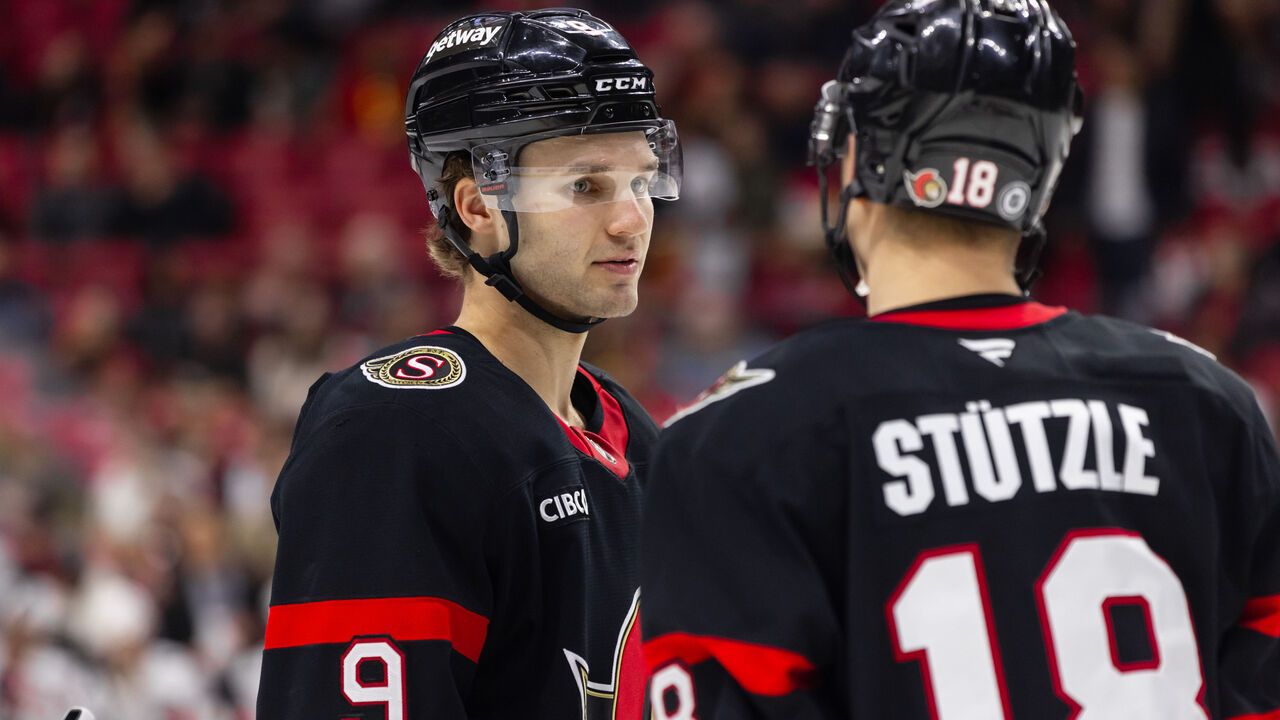
According to PuckPedia, 296 players currently on NHL rosters have partial or full trade protection. That's a whopping 37% of the entire player pool.
Still, 63% of players - including hundreds of youngsters ineligible for no-trade or no-movement clauses - are exposed in the lead-up to the March deadline.
"Sometimes you get caught off guard, and I definitely got caught off guard," Sabres forward Josh Norris said of being traded by the Senators last March.
Norris, just a few years into his eight-year deal with Ottawa, was part of a five-piece deadline-day stunner that also featured Dylan Cozens. Already suited up and about to step onto the ice for Senators practice, Norris was suddenly told he'd been traded. "Shit. Where am I going?" he wondered, stunned by the news.
"They didn't tell me the team until about a half hour later," Norris added.
Norris considers himself lucky. Single and with no children or pets, the then-25-year-old didn't have to worry about anyone but himself in the wake of the trade. What makes things easier is that the acquiring team always solves the logistical puzzle.
In Carolina, for instance, Hurricanes team operations assistant Mallory Wilmoth snaps into action the moment a trade is being finalized. GM Eric Tulsky officially welcomes the player into the organization with a quick call. Wilmoth, or her manager, is often the second person the player hears from.
"The very first thing is figuring out where he needs to physically go," Wilmoth said of her post-trade checklist. "We need to get him from Point A to Point B."
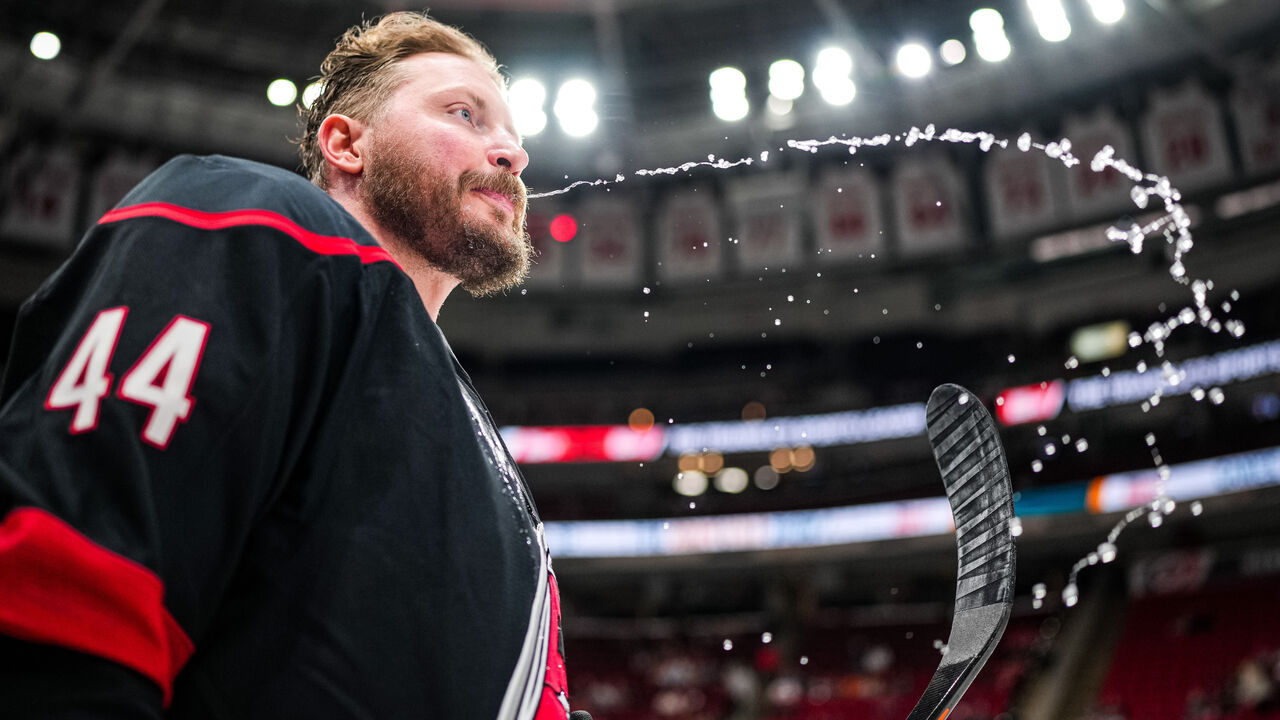
Wilmoth normally hustles to book flights and airport car services, but Carolina's lone deadline acquisition this year didn't require urgent travel. Rather than fourth-line tough guy Nicolas Deslauriers flying out to meet the team in Alberta to close out a road trip, the ex-Flyer drove his pickup truck from Philadelphia to Raleigh. He skated for the first time as a Hurricane on Monday - three days after Friday's deadline.
Corey Perry, sent to the Lightning by the Kings on deadline day, experienced a far more chaotic first 24 hours. He didn't sleep much Friday night as he rushed to Toronto for Tampa Bay's Saturday night game against the Maple Leafs. After a four-hour delay in Los Angeles, the future Hall of Famer's flight landed at 4 a.m. He didn't arrive at the Lightning hotel until 6 p.m. due to customs and immigration. Running on minimal rest and adrenaline, Perry managed to log 15 minutes of ice time and score the 3-2 goal in a 5-2 Tampa win to kickstart the 40-year-old's second tenure with the franchise.
"Playing in Toronto kind of helps. It's the hockey Mecca," Perry said.
Utah acquired MacKenzie Weegar two days before this year's deadline and initially expected the Canadian's visa to be approved within 4-10 days. Instead, the wait was exceptionally short, allowing Weegar to debut Friday night in Columbus.
Mammoth director of team operations Dave Griffins said Weegar's trip from Calgary International Airport to Columbus' Nationwide Arena - which included a connecting flight through Denver - ran roughly eight hours door-to-door. Throughout the trip, Griffins tracked Weegar's luggage online, hoping nothing would get lost in transit: "Are his sticks going to make it? His hockey bag?"
Columbus was bustling last week with the Arnold Strongman Classic bodybuilding event drawing thousands of tourists downtown. Although Weegar was flying in and out on a game day and didn't need a hotel, Griffins booked one anyway. What if Weegar arrived late, couldn't dress for the Blue Jackets game, and wanted a quiet place to relax? Better safe than sorry.
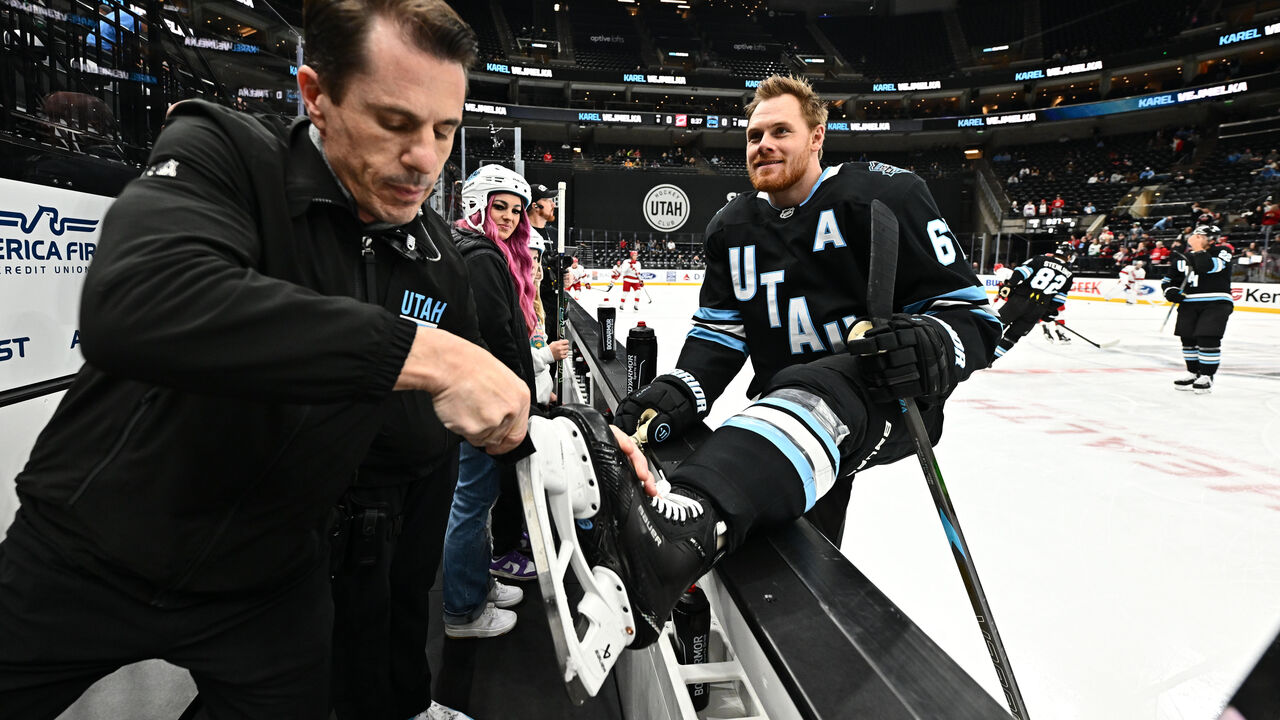
Now in her third season with the Hurricanes, Wilmoth connects a new player with the equipment managers early in the process via a group text chain. Some NHLers are obsessive about gear. Others are laid-back. The immediate tasks are relaying skate and stick specifications and picking a jersey number.
The Hurricanes use the mobile app Teamworks to communicate schedules and itineraries to players. Following a trade, Teamworks automatically moves the player from his old team's account to his new one to streamline the transition.
Additionally, Wilmoth calls the acquired player's partner (if he has one) to check for any pressing needs. She'll also ask for kids' clothing sizes to order customized Hurricanes jerseys with the classic "DAD" nameplate on the back. The Canes sometimes leave a welcoming gift, such as wine, in the player's hotel room.
While team employees and player agents assume key behind-the-scenes roles, the partner often tackles another to-do list. For example, Byram's partner Kailey - his girlfriend in 2024 and now his fiancee - packed up the couple's Denver house after the trade with help from Byram's mom. She then flew to Buffalo, while a friend of a friend drove Byram's truck and two dogs.
"My fiancee handled pretty much everything," Byram said. "I was trying to immerse myself in the team environment, focus on hockey, and she was dealing with stuff back home. There was a lot on her plate during that time."
'Sometimes the stars align'

Like a kid on his first day of school, an NHLer tends to feel a tad anxious following a trade. There's pressure to perform on the ice right away. Knowing a familiar face on the acquiring team can make all the difference.
Defenseman Jordan Spence was exactly that for forward Warren Foegele after his trade from L.A. to Ottawa last week. Upon hearing the news of the move, Foegele texted fellow ex-King Spence nothing but a winking-face emoji.
"I was really confused," a smiling Spence told reporters of his initial reaction. "I was like, 'I have never gotten a text like that before from Foegs ... '"
Every NHL team has a players-only group chat for collecting internal fines, coordinating dinners on the road, and dishing out chirps of all kinds. A player leaves one chat, perhaps wishing good luck on the way out, to join another.
"One day you're a Seattle Kraken, the next you're a Tampa Bay Lightning," is how Tampa forward Oliver Bjorkstrand framed the change, offline and online.

Pierre-Luc Dubois has never been moved during deadline week. However, the Capitals forward has been the new dude on three teams after trades in January and June (twice), making him well-acquainted with the jitters that come with jumping into a players-only chat.
"The hardest one is the first text," Dubois said this past fall at a preseason media event. "When you say hi, it's obviously OK. But the first time putting yourself out there and seeing if nobody answers or everybody does, you're finding out what the enthusiasm level is like. That's the most stressful one."
Bjorkstrand's integration into the Lightning dressing room after last year's deadline was helped by the fact that Yanni Gourde, already a two-time Stanley Cup winner with Tampa, was also included in the same Seattle-Tampa swap.
During their cross-country flight on Tampa's team jet, Bjorkstrand lobbed questions at Gourde about adjusting to his new city and team. Once settled in Florida, the 30-year-old Dane had access to more than 20 peers to turn to for advice, whether he needed a realtor, a veterinarian, or a paediatrician.
"Once you get traded, you have to start thinking about that big-picture stuff. You have to do some groundwork and figure it out. You make it work," said Bjorkstrand, who lives with his wife Jill, three-year-old son Otto, and a dog.
In Griffins' experience, players' children don't typically follow them to the new city after the deadline because it would disrupt their schooling late in the year. Also, many traded players are pending unrestricted free agents, making it impractical to lay down roots for just a few months. The collective bargaining agreement between the NHL and the NHL Players' Association entitles traded players to six months of rent or mortgage payments. In the modern era, fully furnished Airbnb apartments have become a popular option.
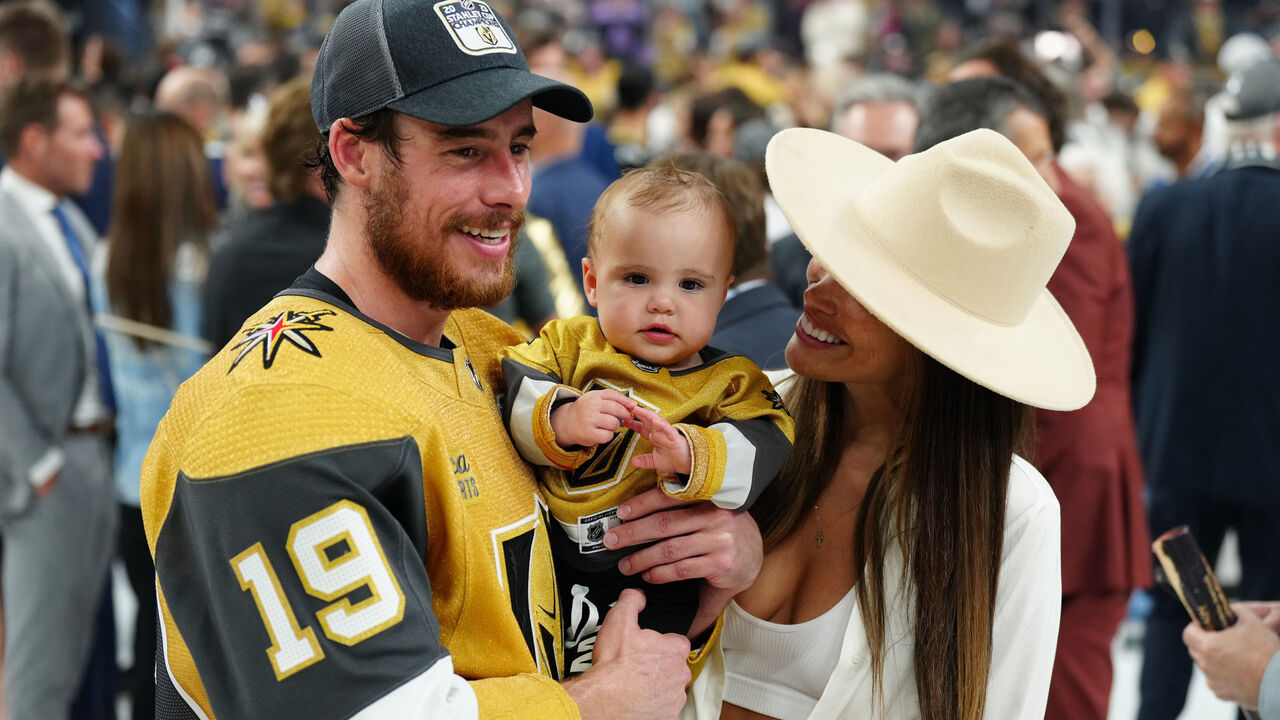
Reilly Smith, a 14-year veteran with stops in six different NHL cities, was held out of three Rangers games last March for "trade-related reasons." With only eight teams on his no-trade list, New York had plenty of flexibility. Ultimately, the Rangers picked Vegas, a dream landing spot for an original Golden Knight.
Smith and his family (wife, two young kids, dog) were thrilled with how everything worked out. In the weeks leading up to the deadline, Smith was in the process of putting their suburban Las Vegas home on the market, only to ditch the idea and gleefully move back in.
"One of the hardest things is not knowing where you're going, and then when you have a family, you have another layer of wondering when you're going to see them again," Smith said. "You might be living in a hotel with them for the next couple of months, the rest of the season, depending on what happens. Those are the tough things that go along with being traded at the deadline."
Smith, 34, signed a one-year extension in the offseason.
"Sometimes the stars align," he said of the deadline-week trade.
John Matisz is theScore's senior NHL writer. Follow John on Twitter/X (@MatiszJohn) or contact him via email ([email protected]).